How to Butterfly a Chicken Breast: A Step-by-Step Guide for Perfect Results
I've butterflied more chicken breasts than I can count. In restaurant kitchens, at home for weeknight dinners, teaching friends who were terrified of ruining a good piece of meat. Let me tell you, mastering this one simple cut is a total game-changer. It turns the notoriously tricky chicken breast—prone to drying out, cooking unevenly, and just being plain boring—into a quick-cooking, flavor-soaking, consistently juicy superstar.
If you've ever sliced into a beautifully seared chicken breast only to find a raw, pink center, or worse, a dry, stringy exterior, you know the frustration. Butterflying solves that. It's not some fancy French technique; it's a practical, 60-second prep step that makes cooking foolproof.
What You'll Learn
Why Butterfly Chicken Breast? The Real Benefits
Everyone talks about even cooking, which is the big one. But let's dig deeper.
Even Cooking is Just the Start. By creating a uniform thickness, you eliminate the guesswork. The thick part isn't waiting for the thin part to catch up, which means no more dry edges. According to food science principles from sources like the USDA's guidelines on safe cooking temperatures, consistent thickness leads to consistent internal temperature, which is safety and quality in one.
It's a Flavor Magnet. A flat, wide surface area means more space for marinades, rubs, and seasonings to cling to. That marinade penetrates better, too. You're not just flavoring the outside; you're giving it more avenues in.
Speed. This is the weeknight winner. A butterflied breast cooks in half the time or less. We're talking 4-6 minutes per side in a pan versus 10-12 for a whole breast. That's dinner on the table before the hunger meltdowns start.
Versatility for Days. Once it's flat, the possibilities explode. You can pound it even thinner for schnitzel or saltimbocca. You can roll it up with fillings. You can grill it, pan-sear it, bake it, or air fry it with perfect results every single time.
The One Thing No One Tells You
Here's my non-consensus take from years of doing this: butterflying isn't just about the cook. It's about portion control and cost-effectiveness. A single large butterflied breast, once flattened, looks substantial on a plate. It can easily feed two people when sliced over a salad or pasta. You buy less, waste less, and feel more satisfied. It tricks the eye and the appetite.
The Right (and Wrong) Tools for the Job
You don't need a $200 Japanese knife. You need a sharp, manageable tool.
The Knife: An 8-inch chef's knife is ideal. A sharp boning knife works too, but its flexibility can be tricky for beginners. The key is sharpness. A dull knife will slip and require you to saw, increasing the risk of cutting yourself and mangling the meat. If your knife can't cleanly slice a tomato with gentle pressure, it's not ready for chicken.
The Cutting Board: Use a stable, non-slip board. Plastic or wood is fine, but place a damp paper towel underneath if it slides. This is a safety step most people skip.
What You DON'T Need: Special "butterfly" knives, scissors (they crush more than cut, leading to ragged edges), or a cleaver. Keep it simple.
How to Butterfly a Chicken Breast: Step-by-Step Guide
Let's get hands-on. Grab one boneless, skinless chicken breast. Pat it dry with paper towels. Moisture is the enemy of a good sear and makes the meat slippery.
Step 1: Find the Tendon and Position the Breast
Place the breast on your board with the smooth side (the side that had the skin) down. The rough, tendon side should be up. You'll feel a tough, white tendon running along one side. This is your landmark. Position the breast so this tendon side is facing you, and the tip (the pointed, smaller end) is pointing away from you.
Step 2: The Initial Cut
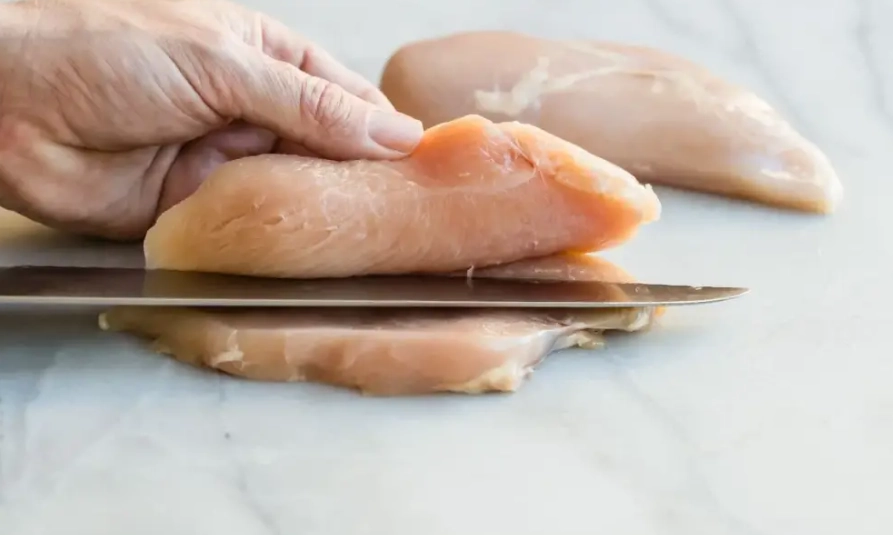
Place your non-knife hand flat on top of the breast to anchor it. With your sharp knife held parallel to the board, start slicing into the thickest side of the breast (the side with the tendon), about 1/2 to 3/4 of the way up. Imagine you're opening a book. Don't cut all the way through. Stop about 1/2 inch from the opposite edge. This is the hinge.
This is where people panic and cut too shallow. You need to be confident. A deep, single smooth cut is safer than several shallow, sawing ones.
Step 3: Open It Up
Now, open the breast like a book along the cut you just made. You'll have one thick piece connected by the hinge.
Step 4: The "Pound" (It's Really a Press)
Here's the pro trick. Don't immediately grab a mallet. Place the opened breast between two pieces of plastic wrap or in a large zip-top bag. Using the smooth side of a meat mallet, a heavy skillet, or even a rolling pin, gently press and flatten the thicker parts to an even thickness—about 1/2 inch is perfect for most cooking. Don't pound aggressively; you're not trying to pulverize it. You're just coaxing it to an even plane. This ensures every part cooks at the exact same rate.
And you're done. Season generously. It's ready to cook.
Safety First: The Grip That Prevents a Trip to the ER
Curl your fingertips of your guiding hand inward, like a claw. Your knuckles should guide the side of the knife blade. This keeps your fingertips out of the blade's path. If your hand slips, the flat of the knife hits your knuckle, not the edge slicing your fingertip. This "claw grip" is non-negotiable.
3 Common Mistakes Everyone Makes (And How to Avoid Them)
- Cutting All the Way Through. You're butterflying, not filleting. That 1/2-inch hinge is crucial. It keeps the breast as one piece for easy flipping and presentation. If you cut through, you just have two uneven cutlets. No big disaster, but not the goal.
- Not Drying the Breast. A wet chicken breast is a slippery, steaming, non-searing chicken breast. Pat it thoroughly dry. This is the single easiest way to improve your sear.
- Using a Dull Knife. I said it before, but it's the root of most bad experiences. A sharp knife goes where you direct it. A dull knife goes where physics takes it, often into your finger. Hone your knife before you start.
How to Cook Butterflied Chicken Breast: Methods Compared
Now for the fun part. Here’s how different methods handle your perfectly prepped breast.
| Cooking Method | Best For | Approx. Cook Time (Per Side) | Key Tip |
|---|---|---|---|
| Pan-Searing (Skillet) | A perfect golden crust, quick weeknight dinners. | 4-6 minutes | Get your pan (cast iron or stainless) screaming hot before adding oil. Don't move it for the first 2 minutes to build that crust. |
| Grilling | Smoky flavor, summer meals, meal prep for salads. | 5-7 minutes | Oil the grates and the chicken. Place it on a clean, hot grill at a 45-degree angle for those picture-perfect marks. |
| Baking/Roasting | Hands-off cooking, cooking for a crowd, adding toppings. | 15-20 mins at 400°F (200°C) | Use a wire rack on a baking sheet. It allows hot air to circulate all around, preventing a soggy bottom. |
| Air Frying | Ultra-crispy exterior with minimal oil, super fast. | 8-12 mins at 375°F (190°C) | Don't overcrowd the basket. A little space ensures crispiness. Spritz lightly with oil for better browning. |
How to Know It's Done (Without Overcooking): Forget cutting it open. That releases all the juices. Use an instant-read thermometer. Insert it into the thickest part. The USDA recommends 165°F (74°C) for safety. For maximum juiciness, pull it off the heat at 160-162°F (71-72°C). The residual heat will carry it to 165°F as it rests. And yes, let it rest for 5 minutes before slicing. This lets the juices redistribute. Skip this, and your juicy masterpiece becomes a dry puddle.
Your Butterflying Questions, Answered
You can, but I don't recommend it for beginners. Shears can crush and tear the meat fibers rather than making a clean slice, leading to ragged edges and uneven thickness. A sharp knife gives you more control and a cleaner cut. If you must use shears, make sure they are extremely sharp and designed for poultry, and be very deliberate with your cut.
Butterflying is the first step; pounding (or pressing) is the optional second step. Butterflying involves slicing the breast open to create a larger, thinner piece. Pounding then takes that butterflied breast and flattens it to a perfectly uniform thickness. You can cook a butterflied breast without pounding if it's already fairly even, but for cutlets (like for chicken Parmesan or piccata), you always pound after butterflying.
Chances are, you skipped the pressing step or didn't press enough. The "hinge" area and the original thick lobe are often still much thicker than the rest. After opening the breast, really check the thickness by eye and touch. Press those thicker spots down until the entire piece is within 1/4-inch of the same thickness. Also, ensure your heat source is even—if using a pan, make sure it's preheated and the chicken is making full contact.
Food safety is paramount. The rule from sources like the FDA's Food Code is simple: don't let raw poultry sit in the "danger zone" (40°F - 140°F / 4°C - 60°C) for more than 2 hours. For a 60-second butterflying job, this is no issue. Work efficiently, put the prepared meat on a clean plate, and either cook it immediately or refrigerate it. The bigger risk is cross-contamination. Use a dedicated cutting board for raw meat, wash your hands, knife, and board with hot soapy water immediately after, and never place cooked food on a surface that held raw chicken.
Absolutely not. Attempting to cut partially frozen chicken is dangerous. The knife can slip easily, and you cannot achieve a clean, even cut. Always thaw chicken completely in the refrigerator before butterflying. For a quick thaw, submerge the sealed breast in cold water, changing the water every 30 minutes. Never thaw at room temperature.
So, there you have it. More than just a cutting technique, butterflying is a mindset. It's about taking control of a finicky ingredient and setting yourself up for success before the heat even hits the pan. Grab a breast, a sharp knife, and give it a try. Your first one might not be perfect, but your third one will be. And your dinners from then on will be faster, juicier, and infinitely more satisfying.
Related Articles